
Los Angeles County Released Inmates
A Los Angeles County release is a custody event, not just a missing name on a jail search screen. LASD operates a large county jail system with downtown, Lynwood, and Castaic facilities. A person can leave LASD custody by bond, own-recognizance order, time served, sentence completion, dismissal, court order, transfer, hospital movement, state-prison commitment, federal hold, or another agency hold. Each route leaves a different trail. A person released from Men's Central Jail is not tracked the same way as a person released from California State Prison, Los Angeles County, and neither path is the same as a federal BOP release.
The practical question is where the person was last held. LASD local custody points first to the LASD Inmate Information Center, the custody phone line, LASD release reports, VINE, Los Angeles Superior Court, and LASD custody records. CDCR custody points to CIRIS, Case Records, DAPO, BPH, and sometimes Los Angeles County Probation through PRCS. Federal custody points to BOP. Immigration detention points to ICE only for that separate custody issue. A released person often drops from a live roster because the live roster is built for current custody.
Los Angeles County Release Types
Release type controls the next record. A bond release may be tied to a court order and bail record. A time-served release depends on sentence and credit calculation. A dismissal or no-file result is usually confirmed through the court or prosecuting record. A transfer to CDCR is not the same as a release to the community, even when the person leaves LASD custody. A parole revocation or PRCS revocation can send a person back into local custody after a prior release.
| Release type | What it means | Where to verify next |
|---|---|---|
| Bond or own recognizance | LASD custody ends because a court or release condition allows the person out before final case end. | LASD release record, LASC case, VINE status. |
| Time served or sentence complete | The local jail sentence or credited time has been satisfied. | LASD record, court minute order, custody records request. |
| Transfer to CDCR | The person leaves county custody for state prison, not necessarily the community. | CDCR CIRIS, CDCR Case Records, BPH or DAPO where relevant. |
| PRCS, parole, or probation path | The person is outside custody but remains under a supervision agency. | Los Angeles County Probation, CDCR DAPO, court terms. |
| Other hold or detainer | LASD custody may end, but another agency may take custody or delay release. | Court, LASD records, BOP, ICE, or receiving agency records. |
Century Regional Detention Facility adds a local safe-release angle for women in custody. LASD policy research identified safe-hour release procedures for female inmates at CRDF. That does not create a public release time promise. It does show why a Los Angeles release may involve paperwork, identity checks, property, safety planning, and transportation before a person physically leaves custody.
Los Angeles County Release Records
A Los Angeles County release record answers a narrow custody question: how did this booking stop being an active LASD hold? California Government Code section 7923.610 identifies the time and manner of release, or the current holding location, as arrest information state and local law enforcement must make public unless a legal limit applies. That statute is the main public-record bridge between a booking and a release confirmation.
The online LASD release PDFs do not show a complete discharge packet. The current Inmate Release Report inspected in the research showed a snapshot time, Projected Release Date, Booking No, Last Name, and First Name. The Pending Releases PDF showed a snapshot time, Booking No, Last Name, and First Name. A fuller release record may require LASD custody records or court records.
| Field | What it shows |
|---|---|
| Booking number | The LASD booking identifier that ties release research back to the custody event. |
| Projected or actual release date | A date tied to expected LASD release processing or confirmed custody end, depending on source. |
| Time and manner of release | The public-record item most useful for confirming how custody ended. |
| Releasing facility | The LASD jail, state prison, city jail, or other custody level involved. |
| Release reason or next agency | Bond, court order, time served, transfer, parole, PRCS, detainer, or other route when available. |
| Court connection | Case, charge, sentence, warrant, bail, or disposition context that may explain the release. |
Obtain Los Angeles Release Records
When online tools do not answer the release question, the formal route is the LASD records process. LASD's Record Requests page separates Records and Identification Bureau services from custody-related California Public Records Act requests. For jail release and inmate-record questions, the custody-related CPRA route is usually the better fit because LASD lists booking information, incarceration records, inmate information, custody incidents, and custody statistical data under that path.
- Identify the last known custody source: LASD, CDCR, BOP, ICE, LAPD city jail, or court.
- Search current custody first through the LASD Inmate Information Center or call 213-473-6100.
- Check LASD's release-related reports from the Custody Reports page if the person was recently in LASD custody.
- Use the custody-related CPRA route for formal LASD jail records or inmate information.
- Use the court case when the release depends on bail, dismissal, sentence, credits, or a minute order.
- For a state-prison release, route records questions to CDCR Case Records or the CDCR Identification Unit rather than LASD.
LASD Records and Custody Contacts
Records and Identification Bureau Public Services Section
12440 East Imperial Hwy., Suite 120 West
Norwalk, CA 90650
Phone: 562-345-4441
Hours: Monday-Thursday, 8:00 a.m. to 4:30 p.m., by appointment
Custody status line
213-473-6100, available for LAPD or LASD jail custody information.
Purpose-neutral request wording works best: ask for booking and release information for the named person, the booking number if known, arrest date if known, and the date, time, manner, release reason, releasing facility, and public booking information available under Government Code section 7923.610. If a part is withheld, ask for the specific exemption and any segregable nonexempt parts.
California Release Record Laws
California law makes some release information public, but it does not open every custody file, medical detail, juvenile record, sealed matter, video, or booking photo. Government Code section 7923.610 covers arrest information, including the time and manner of release or the current holding location, subject to safety and investigation limits. That is why release date and release manner can often be requested even when a live roster is no longer useful.
Record cleaning also needs careful wording in Los Angeles County. California Courts says true expungement does not exist in California, although there are ways to clean a record. Los Angeles Superior Court discusses petitions under Penal Code section 1203.4, and Los Angeles County Library works with the Public Defender's Office on clean-your-record clinics. These processes can affect public court display, but they do not mean every agency record vanishes from every system.
Important: a cleaned, sealed, or limited court record can change public access, but the effect depends on the exact order and the agency holding the record.
Find Released Los Angeles Inmates
The best Los Angeles County released-inmate search is a sequence. Start with the system that matches the last known custody, then move outward. A person who is still in LASD custody is a current-custody lookup. A person no longer shown in the current LASD system may have been released, transferred, moved to court, sent to a hospital, committed to state prison, taken by another agency, affected by a data lag, or searched under a mismatched name or date of birth. Do not treat absence from a live roster as proof of release.
- For LASD custody, search LASD Inmate Information Center or call 213-473-6100.
- Review release-related PDFs linked from the LASD Custody Reports page.
- Use VINE for a specific-inmate custody status check and release or transfer notification.
- Check Los Angeles Superior Court criminal case access for release orders, sentence, bail, disposition, or warrant context.
- Use CDCR, BOP, or ICE only when the facts point to state, federal, or immigration custody.
- Request LASD custody records when online sources do not give the formal date, time, and manner of release.
The 24-Hour Releases page focuses on same-day feed questions, while this home page is the broader named-person search and release-record path.
CDCR Search for Released Inmates
CDCR is the state-prison path for Los Angeles County defendants or residents who entered California prison, including California State Prison, Los Angeles County in Lancaster. The California Incarcerated Records and Information Search, known as CIRIS, is not the first tool for a person who only left LASD custody on bond, court order, or time served. It becomes the right tool when the person was committed to state prison or when release-date research depends on state custody terms.
The CA.gov CIRIS service page states that CIRIS results include name, CDCR number, age, current location, commitment counties, admission date, and BPH dates and outcomes for currently incarcerated persons. If a person is no longer in current CDCR custody, the public search may not provide a full historical discharge record. CDCR Identification Unit, Case Records, DAPO parole offices, BPH hearing results, and the sentencing court may be needed.
| CDCR field or source | Release use |
|---|---|
| CDCR number | Best identifier for state-prison records and case records follow-up. |
| Current location | Shows current prison custody when displayed, not an LASD release. |
| Commitment county | Can tie a state prison record back to Los Angeles County court commitment. |
| BPH dates and outcomes | Useful when parole-suitability proceedings apply. |
| CDCR Identification Unit | Phone path listed by CA.gov for records help: 916-445-6713. |
The CA.gov CIRIS service page shows the state search context and fields. That state source is useful when a Los Angeles County jail case has become a state-prison release question.
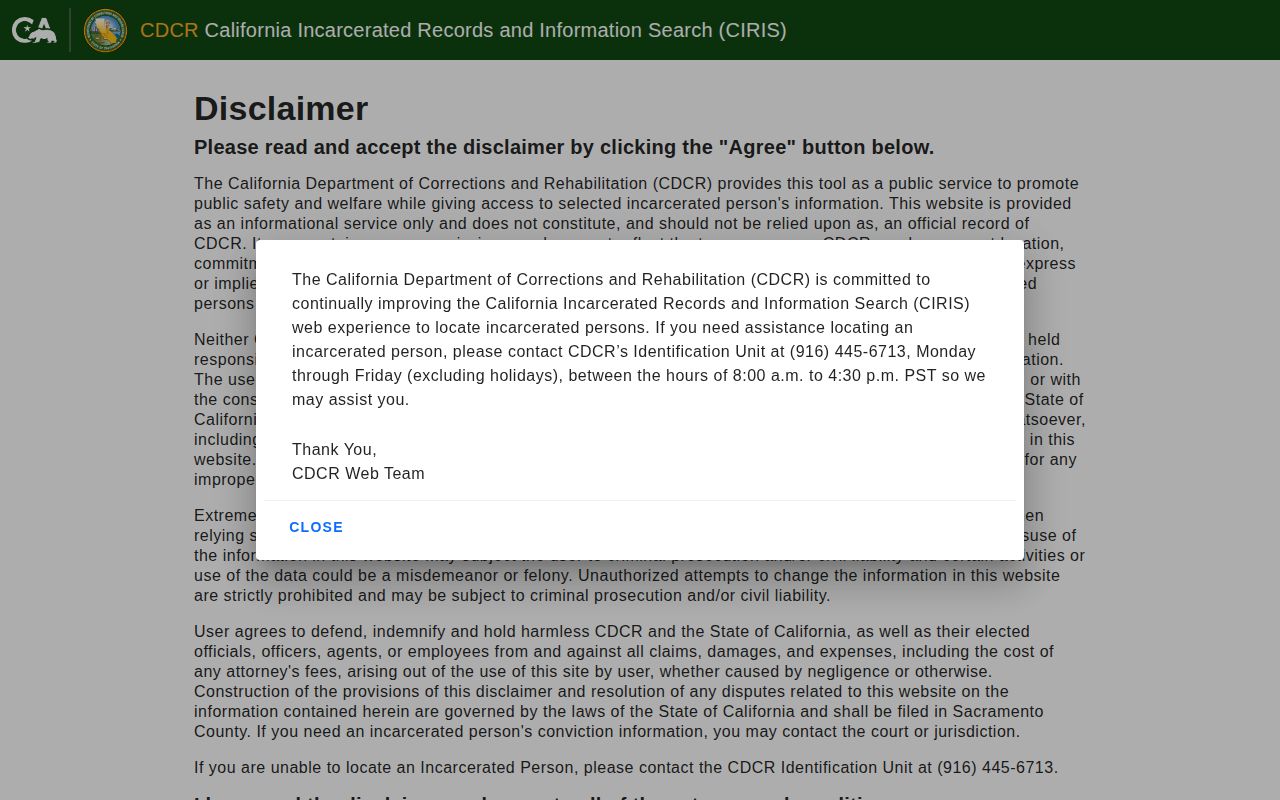
CIRIS should be read with agency boundaries in mind: state prison release records are not LASD county jail release records.
Los Angeles County Recent Releases
Los Angeles County has release-related LASD PDFs, but the research did not locate a true public rolling list of people already released in the last 24 or 72 hours. LASD's visible public links on the Custody Reports page are "Inmate Releases" and "LASD Pending Releases." The first is a projected-release report. The second is a pending-release snapshot. Those names are easy to misread, so the distinction matters.
| LASD source | Fields found | How to use it |
|---|---|---|
| Inmate Release Report PDF | Snapshot time, Projected Release Date, Booking No, Last Name, First Name. | Projected release lead, not proof that release already occurred. |
| Pending Releases PDF | Snapshot time, Booking No, Last Name, First Name. | Release-imminent lead, not a completed-release archive. |
| Booking Log | Booking-oriented portal controls. | Booking context only unless paired with a release source. |
For Los Angeles County released inmates, a current PDF is a snapshot, not a permanent archive. A browser find inside the PDF can help, but the formal release answer still comes from a custody record, a court disposition, VINE status, or an agency response.
Los Angeles Court Release Checks
Los Angeles Superior Court records often outlive the jail roster. A criminal case can show disposition, bail or release order, sentence, sentence credits, warrants, probation terms, dismissal, and later record-cleaning activity. LASC's online criminal case access can be searched by case number and has name-search access, but LASC warns that online information is not the official court record. That warning is important in a high-volume county where custody and court updates may not move at the same pace.
For CDCR resentencing release, the court link is even stronger. CDCR says certified amended abstracts or minute orders must come directly from the sentencing court before release processing can be completed. A court order may start the process, while Case Records still verifies paperwork, checks commitments, applies credits, reviews detainers, and completes notices. Court data and custody data should be read together.
Los Angeles Post-Release Supervision
Released does not always mean unsupervised. CDCR's Division of Adult Parole Operations handles state parole. Los Angeles County Probation handles county probation and PRCS for many people released from California state prison under realignment. LA County Probation's AB 109 page states that certain non-violent, non-serious, non-sex offenders released from state prison are supervised locally by county probation rather than state parole. CDCR defines PRCS as supervision after release from a CDCR institution to the jurisdiction of a county agency.
ODR is another Los Angeles-specific release landscape source. The Los Angeles County Office of Diversion and Reentry reports bringing more than 14,000 people out of jail and into community care since 2015. That figure is not a person lookup. It is local context for why release can connect to diversion, reentry, parole, probation, PRCS, court, and health systems. Post-release supervision details are covered in the Post-Release Supervision page.
- Parole
- State supervision after a qualifying prison release, handled by CDCR DAPO.
- Probation
- Court-ordered county supervision, often tied to the criminal case.
- PRCS
- County-level supervision after CDCR release for eligible realignment cases.
- Discharge
- The end of custody or supervision under the controlling agency record.
VINE Federal and ICE Releases
VINE is the strongest notification channel for a specific Los Angeles County jail person because it is built around custody status changes. California VINE is available at VINELink, and Los Angeles materials give the local phone path 1-877-VINE-4LA / 1-877-846-3452. LAPD's VINE page says callers enter a name or booking number, receive custody status, then can register for release or transfer notification with a phone number and four-digit PIN.
Federal and immigration paths are separate. The BOP Inmate Locator covers federal inmate records from 1982 to the present and can show "Released" or "Not in BOP Custody." That does not prove an LASD release. ICE's locator is for current ICE custody or recent CBP custody, not a Los Angeles County jail release archive. LASD policy also states deputies do not enforce federal immigration laws during routine stops or calls, so an ICE transfer should be confirmed by facts, not assumed from silence in the LASD locator.
Q: Can VINE replace a formal LASD release record?
A: No. VINE can report a custody-status change and send a release or transfer alert, but formal date, time, and manner of release should be verified through LASD records or the court.
Released Versus Current Custody
The same name can require different systems depending on whether the person is still held, projected for release, already released, transferred, or under supervision. The table below keeps the Los Angeles County release paths separate.
| Question | Best starting point | Limit |
|---|---|---|
| Still in LASD or LAPD custody? | LASD Inmate Information Center or 213-473-6100. | Current custody, not a historical release archive. |
| Projected for LASD release? | LASD Inmate Release Report or Pending Releases PDF. | Snapshot lead, not final discharge proof. |
| Released from county jail? | LASD custody record, court case, VINE status. | May require a CPRA request. |
| Released from state prison? | CDCR CIRIS, CDCR Case Records, DAPO, BPH. | Not an LASD record. |
| Released from federal custody? | BOP Inmate Locator. | Federal status only. |
| Possible immigration custody? | ICE locator, court, LASD records, immigration case channels. | Current ICE custody, not a county archive. |
Los Angeles Release Facilities
Los Angeles County release research starts with the facility or custody path. Downtown releases may involve the Inmate Reception Center, Men's Central Jail, or Twin Towers. Lynwood releases may involve Century Regional Detention Facility. Castaic releases may involve the Pitchess complex and transportation planning different from downtown pickup. State-prison releases from California State Prison, Los Angeles County use CDCR, not LASD. Federal and ICE paths have their own locators.
- Los Angeles County Jail System
- Inmate Reception Center
- Men's Central Jail
- Twin Towers Correctional Facility
- Century Regional Detention Facility
- Pitchess Detention Center - North Facility / North County Correctional Facility
- Pitchess Detention Center - South Facility
- Pitchess Detention Center - East Facility
- California State Prison, Los Angeles County
- Los Angeles Police Department jails and temporary holding facilities
- Federal Bureau of Prisons facilities serving federal cases
- ICE / immigration detention path for Los Angeles County arrests
Pitchess/Castaic is a distinctive Los Angeles release setting because distance and facility geography affect pickup planning. That local issue does not change the records path: a county release still needs LASD status, VINE, court context, and custody records when formal proof is required.