
Los Angeles VINE Coverage
California VINE is available through VINELink. The state page describes a free, secure, confidential way to access custody status and criminal case information, locate an offender, and register for notifications. For Los Angeles County, LAPD's VINE instructions describe a local phone path, 1-877-VINE-4LA / 1-877-846-3452, for custody status and release or transfer notification.
LAPD says VINE monitors inmate activity in the Los Angeles County Jail System and calls when an inmate is transferred or released. That makes it useful when LASD's current custody search, pending-release report, or projected-release report does not answer a one-person status question. VINE should still be treated as a status and notification tool, not a complete historical archive.
The California VINE landing page is the matched public source for the web check.
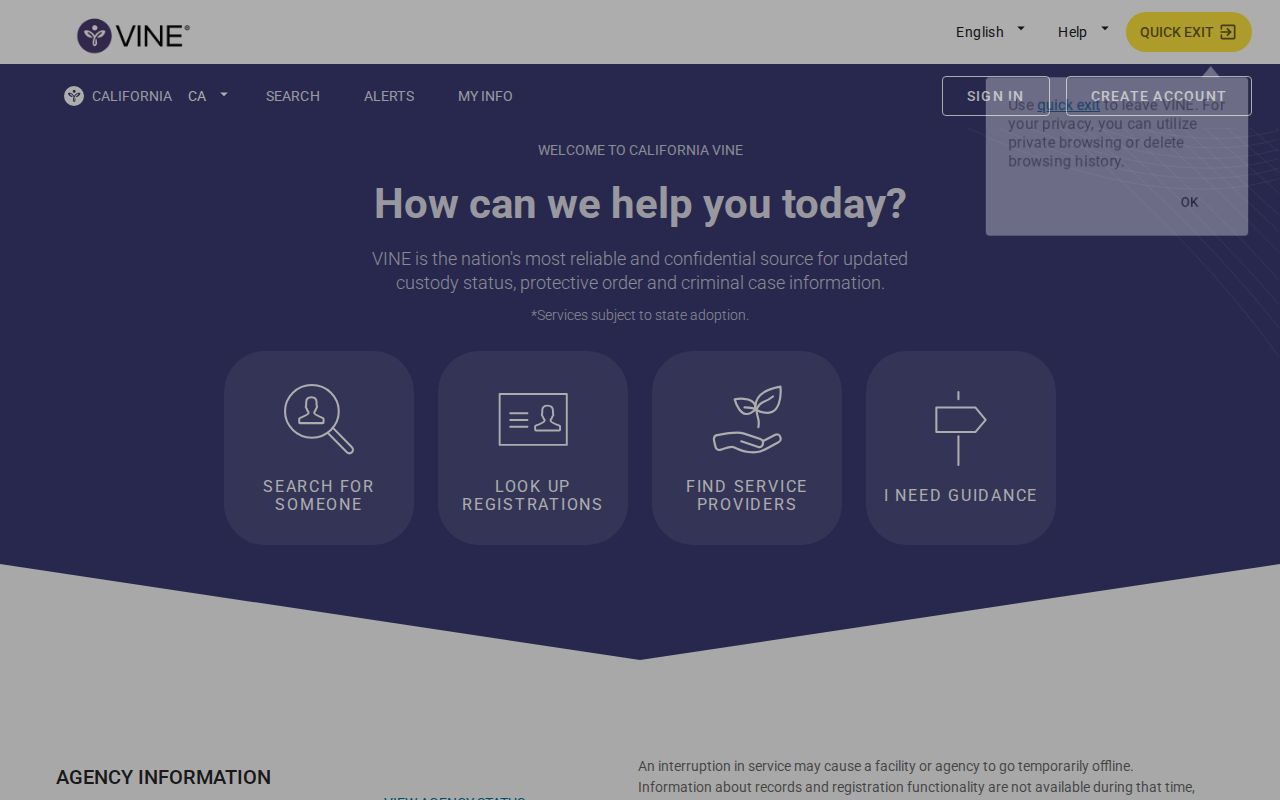
The image shows the state VINE entry point used for custody status and notification registration.
Los Angeles VINE Phone Steps
The local phone workflow is unusually specific. LAPD says callers can enter an inmate's name or booking number by telephone keypad, receive immediate custody status, and then register for notice after the status is provided. A booking number is useful in Los Angeles County because common names can create mismatches.
- Call 1-877-846-3452, also described as 1-877-VINE-4LA.
- Follow the prompts and enter the person's name or booking number.
- Listen to the custody status returned by VINE.
- If the person is in custody and notification is needed, select option 1 after the status is given.
- Provide a direct phone number and create a four-digit PIN.
The PIN is not a minor detail. LAPD explains that the PIN verifies that a successful notification has been made. Entering the correct PIN is the way to stop future notification calls after VINE calls about the release or transfer.
Search Los Angeles on VINELink
The web path is best when you want a screen-based custody check rather than a phone call. Choose California, search for the person, and use identifying details from the booking or court record to avoid confusing similar names. If the person was only in federal custody, VINE is not the right system. If the person was in LASD custody, VINE may help with release or transfer notice. If the person was in CDCR custody, also use CDCR records for state-prison release dates and case-record issues.
| Search item | Why it matters | Limit |
|---|---|---|
| Name | Starts the VINE person search | Common names may return multiple matches |
| Booking number | Improves matching in the Los Angeles phone workflow | Not always known to family or the public |
| Custody status | Shows whether custody data has changed | Does not replace a formal release record |
| Release or transfer notice | Alerts when the custody status changes | VINE is not a long-term archive |
Los Angeles VINE Release Results
The research did not locate an official Los Angeles sample screen listing exact released-result labels. Use careful wording. VINE can tell you whether custody status has changed and can notify you of release or transfer. It should not be described as showing every field from an LASD release record, a court minute order, or a CDCR case file.
For a release record, the key question is still the date, time, and manner of release. California Government Code section 7923.610 identifies that information as public arrest information, subject to limits. VINE helps you know that something changed. LASD records, the court case, or CDCR records explain the formal basis and final details.
Register Los Angeles Release Notices
VINE registration is event based. LAPD says callers register after custody status is provided. The person registering gives a phone number and PIN. LAPD also warns not to use a number that reaches a switchboard, because VINE needs to reach the person receiving the notice. Notifications may arrive in the middle of the night because VINE begins calling when new custody information is received.
- Confirm the person is the correct match before registering.
- Register only after the VINE status prompt offers that option.
- Use a phone number that reaches the person who will answer the notification.
- Save the four-digit PIN.
- When VINE calls, enter the PIN to verify receipt and stop the call cycle.
VINE is helpful for family knowledge and custody-status notice, but LAPD's local page says not to depend on VINE for personal safety. If a court order, protective order, or immediate safety issue exists, use the appropriate official channels.
Los Angeles VINE Limits
VINE does not solve every Los Angeles County release question. It is not a BOP locator. It is not an ICE detainee locator. It is not a mugshot source. It is not a full release-record request system. A person can also leave the LASD current locator because of transfer, court movement, hospital movement, another hold, sealed or limited data, or a name mismatch.
Match the system to the custody path. Use LASD sources for Los Angeles County jail custody, CDCR CIRIS and CDCR records for state prison, BOP for federal custody, ICE only for immigration detention, and the court case for orders and disposition. The wider named-person workflow is covered on the Los Angeles County released inmates page.
Note: VINE can be the fastest alert, but it is not the last word on the release record.
Confirm After Los Angeles VINE
After a VINE alert, the next step is to confirm the record behind the notice. For LASD custody, compare the alert with the Inmate Information Center, the release-related reports on the Custody Reports page, and the court case. If the person was released from a state prison, compare the alert with CDCR records, Case Records information, DAPO parole context, or BPH dates when parole suitability applies. If the person entered another agency's custody, the next system may be CDCR, BOP, ICE, another county, or the court.
VINE is useful because it reacts to custody data, but the official record may use different wording. LASD records may describe a release reason, a transfer, a warrant hold, or the facility that released the person. CDCR records may describe EPRD, parole eligibility, PRCS assignment, detainers, or release processing. The court case may explain a bail order, sentence, dismissal, or resentencing order. Those details help distinguish a release to the community from a transfer out of LASD custody.
VINE vs Other Los Angeles Records
Use VINE when the task is notification. Use LASD records when the task is the formal date, time, and manner of a county-jail release. Use CDCR when the task is state-prison custody, release processing, or parole-related dates. Use Los Angeles Superior Court when the task is the order or sentence behind the custody change. Use the California Megan's Law registry only for qualifying registrants and only within that registry's legal limits.
| Need | Best source | Why |
|---|---|---|
| Release or transfer alert | VINE | Built for custody-change notification |
| LASD release reason | LASD custody records | Formal local release details come from the holding agency |
| State prison release date | CDCR and BPH records | CDCR uses state-prison release and parole-date terms |
| Court order behind release | Los Angeles Superior Court | The case record can explain bond, sentence, dismissal, or warrant status |
Phone vs Web VINE
The Los Angeles phone path and the California VINELink web path serve the same broad custody-notification purpose, but they fit different situations. The phone path is useful when the user has a booking number, can follow keypad prompts, and wants to register a direct phone number with a PIN. The web path is useful when the user needs a screen-based search, wants to compare matches, or is starting with a name rather than a booking number.
Both paths still require caution. Common names can create the wrong match. A booking number from an old arrest can point to a different custody event. VINE may report a release or transfer before a public report has refreshed, or the public report may show a pending release while VINE has not yet sent notice. That is why the final confirmation should come from LASD, CDCR, or the court, depending on the custody path.
| VINE path | Use it when | Extra check |
|---|---|---|
| Los Angeles phone line | You have a booking number or want phone notification | Save the PIN and confirm the release with LASD records |
| California VINELink web | You need to search and compare possible matches | Verify the person against booking or court details |
| CDCR-related VINE notice | The person may move from county jail to state custody | Check CDCR CIRIS or Case Records for state-prison details |
When VINE Is Not Enough
Some release questions need records that VINE does not provide. If the issue is the release reason, use LASD or the court. If the issue is whether a CDCR date was calculated correctly, use CDCR Case Records, CDCR Identification Unit, or the sentence-calculation routes described by CDCR. If the issue is a warrant or new court action, use the Superior Court record and current custody search.
VINE also should not be treated as a registry, a photo source, or a federal locator. BOP has its own inmate locator for federal sentences. ICE has its own detainee locator for current ICE custody questions. California Megan's Law has its own disclosure rules for registrants. Keeping those systems separate prevents a release alert from being stretched into facts it does not show.